AI biometrics is reshaping how governments issue IDs, how banks onboard customers, and how organisations secure physical and digital access. For decision-makers navigating vendor choices, regulatory frameworks, and procurement requirements, the terminology can be a barrier.
What is AI Biometrics?
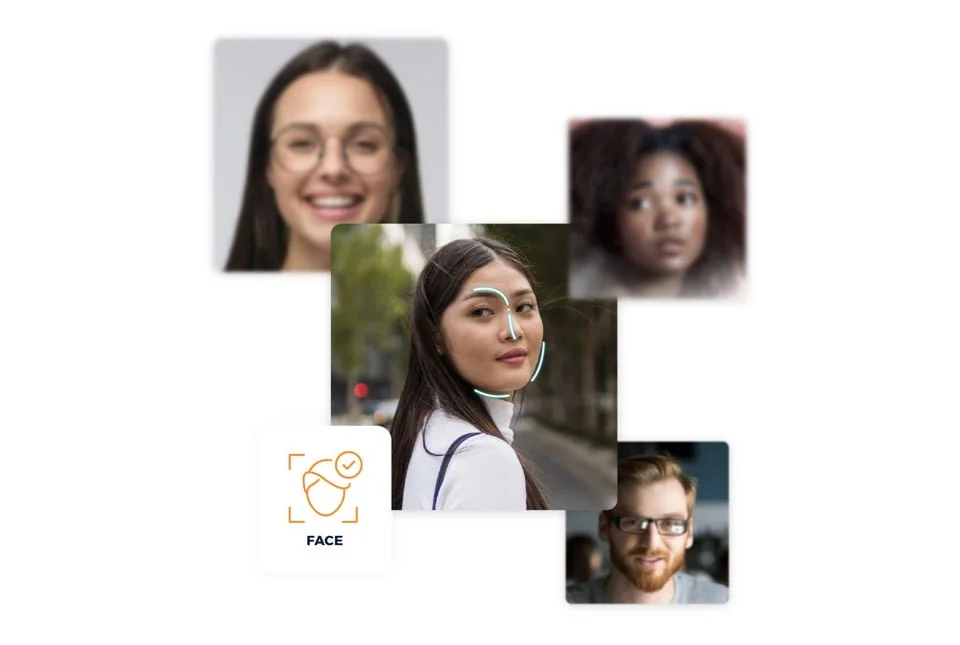
AI biometrics refers to the use of artificial intelligence (especially machine learning and deep learning) to recognize, analyze, and verify individuals based on their unique biological or behavioral characteristics.
Traditional biometrics (like fingerprint scanners) rely on simple pattern matching. AI biometrics adds adaptive learning, which improves accuracy over time and handles variations in real-world conditions (e.g., changes in lighting, aging, or partial data).
Besides that, AI biometrics encompasses fingerprint recognition, facial recognition, iris recognition, voice recognition, palm vein recognition, and behavioral biometrics. Unlike rule-based legacy systems, AI biometric systems continuously learn and improve in accuracy from large, diverse datasets.
How AI Biometrics Works?
The journey of AI biometrics starts with a sensor (camera, microphone, or scanner) capturing raw biological data.
Preprocessing: The AI first cleans the data, adjusting for lighting, noise, or orientation. For example, if you are scanning your face in a dark room, the AI uses “Generative Adversarial Networks” (GANs) or enhancement filters to normalize the image.
Feature Extraction via CNNs: Modern systems use Convolutional Neural Networks (CNNs). Instead of looking for “a nose” or “an eye,” the CNN passes the image through dozens of layers that detect edges, textures, and eventually complex 3D structures.
Creation of “Embeddings”: The most critical step is converting these features into a mathematical vector called an embedding. This is a long string of numbers that represents your unique identity. The actual photo or fingerprint is often discarded; only this mathematical “digital twin” is stored.
Multimodal Fusion
High-security systems rarely rely on just one trait. AI Fusion allows a system to look at several modalities simultaneously:
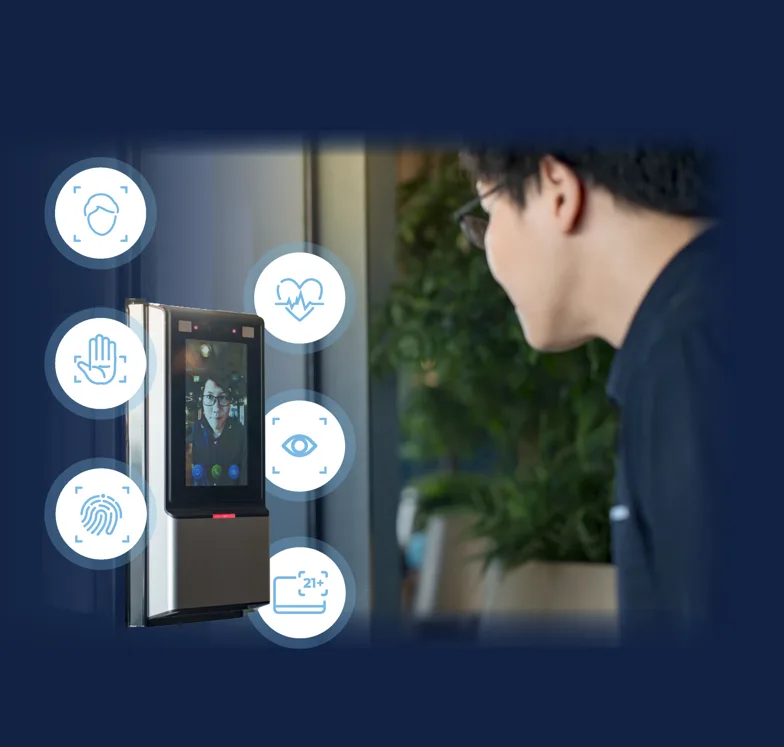
Physiological: Face, iris, fingerprint, and even finger vein patterns (which are nearly impossible to spoof).
Behavioral: AI monitors the way you type (keystroke dynamics), the angle at which you hold your phone, and even your gait (the way you walk).
The Decision Engine: AI uses “Score-Level Fusion” to weigh these inputs. If your face matches at 90% but your typing pattern is only 20% consistent with your history, the AI may flag the session as suspicious and request a second factor.
Liveness Detection (Anti-Spoofing)
One of the greatest advancements in AI biometrics is the ability to distinguish a real human from a high-resolution photo, a video, or even a deepfake mask.
Active Liveness: The AI asks you to perform a random action, like blinking or turning your head.

Passive Liveness: This is the 2026 standard. AI algorithms analyze micro-textures of the skin, the way light reflects off a real eye versus a screen, and even sub-perceptible pulse movements in the face (rPPG). If the texture of the input doesn’t match biological skin, the AI rejects it instantly.
Comparison and Verification
When you attempt to log in, the AI performs a real-time comparison:
It generates a fresh embedding from your current scan.
It compares this new vector against the stored template using distance metrics.
If the mathematical distance between the two vectors is below a certain threshold (meaning they are nearly identical), access is granted.
Core AI Technologies in Modern Biometrics
Deep Learning
A subset of machine learning that uses multi-layered artificial neural networks to extract hierarchical feature representations from raw data. In AI biometrics, deep learning enables state-of-the-art accuracy in facial recognition, fingerprint minutiae detection, and iris segmentation by training on millions of labelled samples. Modern biometric algorithms based on deep learning significantly outperform traditional hand-crafted feature extraction approaches.
NIST FRVT is the National Institute of Standards and Technology’s ongoing, independent benchmark for face recognition algorithms. It is the global gold standard for assessing the accuracy, speed, and fairness of facial recognition systems. A top ranking in NIST FRVT is widely regarded as the most credible indicator of algorithm quality when evaluating vendors.
Liveness Detection determines whether a biometric sample originates from a live, physically present person rather than a spoof artefact such as a printed photograph, a 3D mask, or a video replay. It is a mandatory component in regulated identity verification. Methods include passive liveness (invisible to the user), active liveness (user prompted to move or blink), and challenge-response mechanisms.
Deepfake Detection

Deepfake detection is a specialized AI capability that identifies synthetically generated or manipulated media, including AI-generated faces, voice clones, and video injections – designed to bypass identity verification systems. As generative AI advances, deepfake detection has become a critical security layer in digital onboarding and remote authentication for banking, government, and telecom.
Optical Character Recognition (OCR) for Identity Documents
The AI-powered extraction of textual data from identity documents including passports, national ID cards, and driving licenses. Biometric OCR reads the Machine Readable Zone (MRZ), Visual Inspection Zone (VIZ), and barcodes, enabling automated data capture during onboarding with high speed and accuracy.
Systems, Platforms & Deployment of AI Biometrics
Deploying AI biometrics requires integrating complex machine learning models into robust operational architectures:
ABIS (Automated Biometric Identification System)
A large-scale software platform that automates the capture, storage, indexing, and matching of biometric data across populations. ABIS is the backbone of national identity programmes, border control systems, voter registration systems, and criminal justice databases. A modern ABIS supports multimodal biometrics (fingerprint, face, iris), deduplication, watchlist screening, and court-ready audit trails.
A specialised biometric identification system dedicated to fingerprint matching. AFIS solutions are widely used in law enforcement for ten-print and latent fingerprint identification. Modern AI-powered AFIS systems dramatically outperform legacy solutions in both speed and accuracy.
Digital Onboarding / eKYC
The remote, fully digital process of verifying and registering a new customer or citizen using AI biometrics and automated document verification, without requiring in-person attendance. Digital onboarding typically combines document OCR, facial biometric matching, and liveness detection to satisfy Know Your Customer (KYC) and Anti-Money Laundering (AML) regulatory requirements.
Video Analytics & Real-Time Face Recognition Platform
A real-time face recognition platform designed to process multiple simultaneous video streams for applications including access control, event security monitoring, border surveillance, and law enforcement video investigation. These platforms integrate directly with existing CCTV infrastructure and can match individuals against watchlists in milliseconds.
SDK (Software Development Kit)
A packaged set of biometric algorithms, APIs, and development tools that allows organisations and system integrators to embed biometric capabilities directly into their own applications or hardware devices. OEM SDKs are available for fingerprint, face, and iris recognition and can be ported to constrained hardware environments.
Use Cases of AI Biometrics
National ID / Civil Registry
A government program that issues and manages official identity documents for citizens using biometric enrolment and deduplication. AI biometrics enables population-scale identity assurance, prevents fraudulent duplicate enrolments, and supports interoperability across government services.
eGates
Self-service border crossing kiosks that use facial recognition and travel document verification to automate passenger processing at airports, land borders, and seaports. Automated Border Control (ABC) systems reduce queue times, improve throughput, and maintain security by matching travellers against watchlists in real time.
Biometric Voter Registration
The use of fingerprint and facial biometrics to register eligible voters, prevent duplicate registrations, and authenticate voters at polling stations. Biometric voter registration is a critical tool for electoral integrity in regions where documentary evidence of identity is unreliable.
Biometric KYC for Banking & Fintech
The use of AI-powered biometric identity verification to satisfy Know Your Customer (KYC) regulatory requirements during customer onboarding. Biometric KYC replaces paper-based verification with automated document checking, facial matching, and liveness detection, reducing fraud, cost, and onboarding time.
 Fingerprint Recognition
 Facial Recognition
 Iris Recognition
 Contactless Palm Recognition
 Biometric Face Verification
 Age Estimation
 Liveness detection
 Deepfake Detection
 Identity Document Verification
 NFC Verification