Injection attack detection, or IAD, is the set of controls that tells a biometric system whether the image or video it received actually came from a live capture on a real camera. Remote face verification depends on that answer, because the camera sits on the applicant’s own phone or laptop, outside the control of the bank, trust service provider, or agency running the check.
Without it, an attacker never has to face the lens.
What Happens During an Injection Attack?
Every remote verification follows the same path. A camera captures the face, an app or browser packages the frames, and a server analyzes them. An injection attack cuts into that path after the camera and before the analysis, swapping the genuine stream for something prepared in advance. CEN/TS 18099, the European specification on the subject, describes it as replacing the captured sample before feature extraction begins.
The tools are not exotic. Virtual camera software, built for streaming and video calls, can present any video file to a browser as though it were a webcam. Phone emulators run a mobile app on a desktop where every input can be scripted. On a rooted or jailbroken device, hooking frameworks intercept the moment an app asks the camera for a frame and hand back something else. Some attackers ignore the device altogether and tamper with the traffic between the app and the server.
What gets injected varies just as widely. It might be a genuine video of the victim lifted from social media, a face swap that maps the victim’s features onto the attacker’s movements, or a face generated from nothing. CEN/TS 18099 calls these instruments and keeps them separate from the delivery methods.
Why Isn’t Liveness Detection Enough?
Liveness detection was built for a different threat. Presentation attack detection, its formal name, looks for the physical traces left when someone holds a printed photo, a tablet, or a mask up to a genuine camera. Paper has texture. Screens produce glare and moiré patterns. Masks have edges that do not move like skin.
An injected stream carries none of these traces. If the attacker feeds in an unedited video of the real victim, every frame shows a living person, because it was recorded from one. A good deepfake can blink, turn its head and follow on-screen prompts. The liveness check may judge each frame correctly, and the session is still fraudulent.
The two capabilities are tested under different documents for this reason. ISO/IEC 30107-3 covers presentation attack detection, while CEN/TS 18099 covers injection and leaves presentation attacks outside its scope. A liveness certificate says nothing about virtual cameras or emulators.
Where Do Deepfakes Fit In?
Deepfakes are the content, and injection is one way of delivering it. The distinction shapes detection. A deepfake replayed on a phone held up to a webcam is a presentation attack, and reflections or screen borders may give it away. The same file pushed through a virtual camera arrives clean.
ETSI TS 119 461, the European specification for identity proofing in trust services, reflects this split. It asks providers to detect artificially generated or manipulated faces and, as a separate requirement, to prevent and detect injected video.
An injection attack in progress: streaming software pushes a prepared face through a virtual camera into a selfie verification step running in a phone emulator.
How Do Systems Detect Injection?
No single signal catches every method, so detection works in layers. Each layer answers a narrower question.
The first concerns the environment. Is the app running on a real phone or on an emulator? Has the operating system been rooted? Are debugging or hooking tools active? A native mobile app can ask many of these questions directly, which is one reason mobile capture is easier to protect than a web page.
The second concerns the camera. Real sensors have physical characteristics and behave in recognizable ways as they start, focus and respond to light. Virtual camera drivers often give themselves away through metadata, device naming, frame timing, or the absence of natural sensor noise.
The third concerns the media. Generated and edited video can carry traces of synthesis, blending around the edges of a swapped face, or compression patterns that do not match a fresh capture.
The last concerns the journey from device to server. Signing or encrypting the captured data at the source makes it far harder to replace frames in transit, and ETSI TS 119 461 requires a stream captured on the applicant’s device to reach the provider’s environment securely. The results of all four layers are then weighed together with face comparison and liveness in a single decision.
Does It Work the Same in a Browser?
No. A browser sees much less of the device than a native app, and virtual cameras run easily on desktop operating systems. Web capture can still be protected, mostly through media analysis on the server, but mobile SDK test results do not carry over to a web flow.
What Is CEN/TS 18099?
It is the document laboratories work from when they test IAD. CEN approved CEN/TS 18099, Biometric data injection attack detection, in October 2024. It defines the vocabulary of the field, describes detection approaches and gives evaluators a method for planning tests and rating attacks by the time, expertise, equipment and product knowledge each one requires.
Evaluations run at defined levels, and High is more demanding than Substantial. Some labs also sell graded programs of their own, which are not CEN levels unless the test report states an equivalence.
As a technical specification, it is provisional, with validity initially limited to three years. An international counterpart, ISO/IEC 25456, is being drafted and, as of November 6, 2026, has not been published.
Why Does ETSI TS 119 461 Matter for IAD?
It turned injection attack detection from good practice into a dated requirement for part of the European identity market.
ETSI TS 119 461 V2.1.1, published in February 2025, sets out how trust service providers verify identity before issuing qualified certificates for electronic signatures and similar credentials. For remote face capture, it requires both prevention and detection of injected prerecorded or generated video, and it ties that requirement to independent testing. Providers targeting Baseline identity proofing need their IAD tested by an accredited laboratory to the Substantial level of CEN/TS 18099. Extended identity proofing requires High. Both deadlines fall at the end of 2026, and testing has to be repeated at least every two years.
EU implementing rules, including Regulation (EU) 2025/1566 on qualified certificates, reference the specification with adaptations. Other sectors are not bound by it directly, though many treat it as a benchmark for remote onboarding.
What Does a Passed Evaluation Actually Show?
It shows that a lab, working within a defined scope and attack budget, could not get an injected sample accepted. The scope is narrow by design. A report covers one product version on one platform in one configuration.
The other number worth reading is the bona fide presentation classification error rate, or BPCER, which measures how often genuine users were wrongly flagged. A system tuned to stop every attack is of little use if it also turns away real customers on older phones.
Where Is Injection Attack Detection Used?
Anywhere a face captured on someone else’s device drives an important decision. Banks and fintech companies run it during account opening and recovery. Trust service providers use it before issuing signing certificates, telecom operators apply it to remote SIM registration, and online platforms rely on it to keep fake accounts out. The face video involved is special category data under GDPR when used to identify a person uniquely, so a legal basis and safeguards are required.
Like any component, it covers one part of an identity proofing process. Policies, accepted evidence, manual review, retention and conformity assessment stay with the organization operating the service.
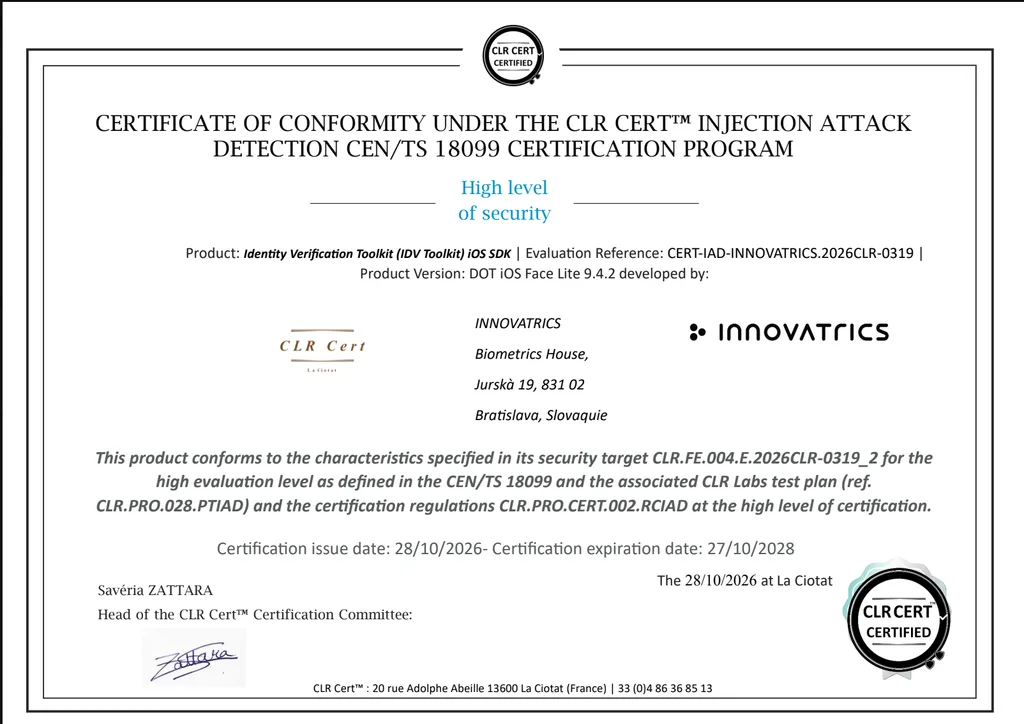
CLR Labs certified injection attack detection in the Innovatrics Identity Verification Toolkit iOS SDK at the High level of CEN/TS 18099.
What Can’t Injection Attack Detection Do?
IAD answers one question: whether a sample came from a real capture. Whether the person is who they claim to be still depends on document checks and face comparison. Attack tools also keep changing, and a detector that passed testing last year may face methods that did not exist then. Retesting and regular updates are part of operating it.
Why Is Injection Attack Detection Important?
Remote onboarding moved the camera from an enrollment desk into the applicant’s hand. Attackers gained control of the one component meant to observe them, and generative AI then made convincing faces cheap to produce.
Injection attack detection checks whether the data reaching the verification engine came from a real capture. It narrows a specific and growing route to identity fraud and gives auditors independent evidence of how well that route is closed. It does not end identity fraud.
 Fingerprint Recognition
 Facial Recognition
 Iris Recognition
 Contactless Palm Recognition
 Biometric Face Verification
 Age Estimation
 Liveness detection
 Deepfake Detection
 Identity Document Verification
 NFC Verification