Enrollment is the process of capturing biometric samples, processing them to create biometric templates, and keeping the templates (usually with additional data) in a database, smart chip, or other storage medium for future identity verification or identification.
What is Biometric Enrollment?
Enrollment in biometrics is the first and most critical step in any biometric identity system. Before a person can ever be verified, authenticated, or identified, their biometric characteristics must be registered. Enrollment is that registration event when the system “meets” the individual for the first time.
The concept is straightforward: a biometric reader captures a physical or behavioral characteristic (a fingerprint scan, a facial image, an iris photograph), specialized algorithms extract the unique features from that raw sample, and a compact mathematical representation called a biometric template is generated and stored. All subsequent authentication attempts compare a freshly captured probe against this enrolled template.
What makes enrollment so consequential and so technically demanding is that every downstream operation in the identity system depends on the quality and accuracy of the enrolled data. A poor-quality template created at enrollment will cause false non-matches for the entire lifetime of that identity record. Getting enrollment right is therefore not a procedural nicety but a mission-critical requirement.
The Enrollment Process Step by Step
While implementations vary by modality and deployment context, the core enrollment workflow follows a consistent sequence of tightly integrated stages. Each stage must be executed correctly for the identity record to be reliable.
Identity Proofing and Document Verification

Before any biometric is captured, an individual’s identity must be established through documentary evidence such as passports, national IDs, or other government-issued documents. Modern systems use automated identity document verification (IDV) and NFC chip reading to cross-check the document’s authenticity in seconds, binding the biographical record to the enrollment session.
Identity Verification Through Passport Authentication
Biometric Sample Capture
The appropriate sensor captures the raw biometric data, a flat-bed or live-scan fingerprint reader, a calibrated camera for face or iris, or a contactless palm scanner. Multiple biometric samples are typically captured per modality (e.g., all ten fingerprints, both irises, multiple facial angles) to maximize template richness and support multimodal fusion.
Quality Assessment
Real-time quality algorithms evaluate each captured sample against standardized quality metrics, NIST NFIQ2 for fingerprints, ISO/IEC 29794 for other modalities. Samples below the configured quality threshold are rejected and recaptured immediately before the subject leaves the enrollment station. Feedback is typically surfaced via on-screen guidance to the operator or subject.
Feature Extraction and Template Generation
Proprietary or standardized algorithms analyze the quality-approved sample and extract a compact set of discriminative features, minutiae points and ridge patterns for fingerprints, nodal geometry for faces, and texture codes for irises. These features are encoded into a biometric template, typically ranging from a few hundred bytes to a few kilobytes, which is then cryptographically protected.
Deduplication Search
Before finalizing enrollment, the new template is searched against the existing database to detect whether the person is already enrolled under a different identity. This one-to-many (1:N) search handled by an Automated Biometric Identification System (ABIS) is the primary safeguard against duplicate registrations and identity fraud in national programs such as voter registration and civil ID issuance.
Template Storage and Record Creation
Once deduplication clears the record, the template and associated biographical data are written to the central database, a smart card chip, or both. The stored identity record is assigned a unique identifier and becomes the reference for all future verification or identification queries against that individual.
Quality Thresholds and Failure to Enroll
A critical metric for any enrollment system is the Failure to Enroll (FTE) rate, the proportion of individuals for whom no usable biometric template can be generated, typically because the sensor cannot capture a sample that meets the minimum quality threshold. FTE is not a fixed property of technology alone; it is sensitive to operator training, environmental conditions, and the demographics of the enrolling population.
Common causes of elevated FTE include worn fingerprints (common in manual laborers and the elderly), skin conditions, injury, extreme dryness or moisture, poor lighting for facial capture, and non-cooperative subjects. Best-practice enrollment systems address these through real-time operator guidance, multi-attempt workflows, and fallback modality capture where a primary biometric sample cannot be acquired.
The Role of ABIS in Biometric Enrollment
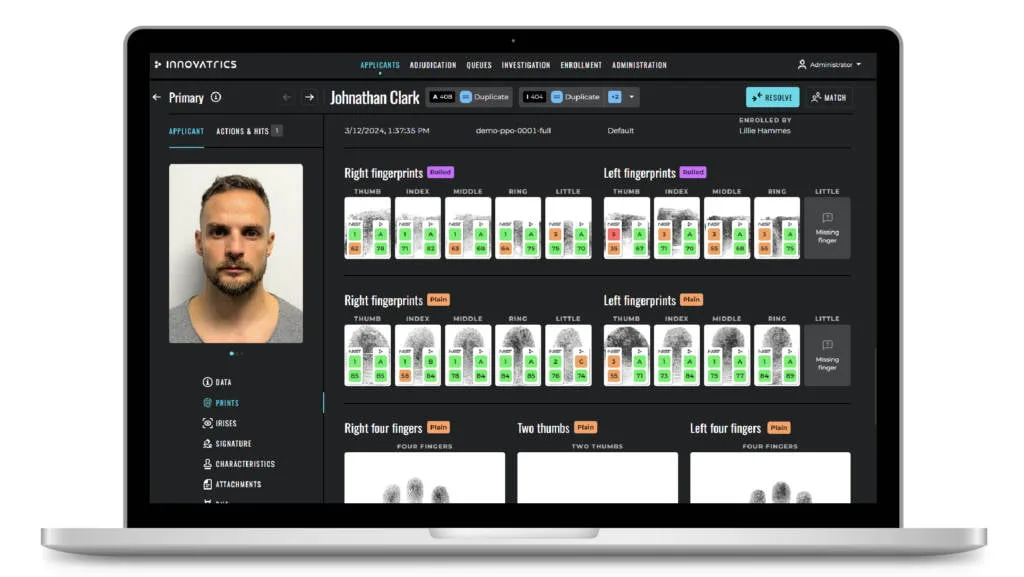
During enrollment, the ABIS conducts a one-to-many (1:N) biometric search: the new enrollee’s template is compared against every existing template in the database, and candidate matches above a configurable similarity score threshold are flagged for human adjudication. In national-scale systems with tens of millions of records, this requires highly optimized indexing algorithms, massive parallel processing, and tiered candidate list management.
An effective ABIS reduces duplicate registrations in national ID programs, prevents welfare fraud and multiple voter registrations, accelerates criminal investigations through rapid latent fingerprint matching, and ensures the integrity of biometric passports and border watch-lists.
Innovatrics ABIS is built for this challenge, delivering sub-second 1:N fingerprint and face search across databases with millions of records, and benchmark-leading accuracy confirmed by independent evaluations including NIST FRVT and NIST PFT III.
Innovatrics ABIS applicant detail
Government and Enterprise Use Cases for Biometric Enrollment
National Civil Registration and ID Issuance
Governments deploying national identity programs enroll citizens’ fingerprints, faces, and irises to create authoritative identity records that underpin ID card issuance, e-passport production, and benefits administration. The enrollment event is the legal and technical anchor of the citizen’s digital identity; everything from voting rights to healthcare access flows from it.
Biometric Voter Registration
Electoral commissions use biometric enrollment to deduplicate voter rolls and issue biometric voter cards. At the polling station, the system ensures only enrolled citizens are eligible to vote and prevents multiple voting and proxy voting, protecting democratic processes in contexts where documentary fraud is a recognized risk.
Border Management and e-Gates
Travelers enrolled in biometric passports or trusted-traveler programs pass through automated e-gates that match a live facial or fingerprint capture against the template stored on the travel document chip. This one-to-one (1:1) verification relies entirely on the quality of the template enrolled when the passport was issued.
Criminal Investigation and ABIS
Law enforcement agencies enroll suspects’ ten-print records following arrest and submit crime-scene latent prints for search against these records and increasingly against national civil ID databases where legal authority permits. The accuracy of the enrolled ten-print database directly determines how many cases can be resolved through automated latent-to-tenprint matching.
Enterprise Digital Onboarding
Banks, telecommunications providers, and fintech platforms use remote biometric enrollment to onboard customers without a physical branch visit. A smartphone camera captures the applicant’s face, liveness detection confirms the subject is present and not a spoof, and the resulting template is stored for future authentication. Regulatory frameworks such as eIDAS 2.0 and FATF guidance are driving the standardization of this remote enrollment process.
 Fingerprint Recognition
 Facial Recognition
 Iris Recognition
 Contactless Palm Recognition
 Biometric Face Verification
 Age Estimation
 Liveness detection
 Deepfake Detection
 Identity Document Verification
 NFC Verification