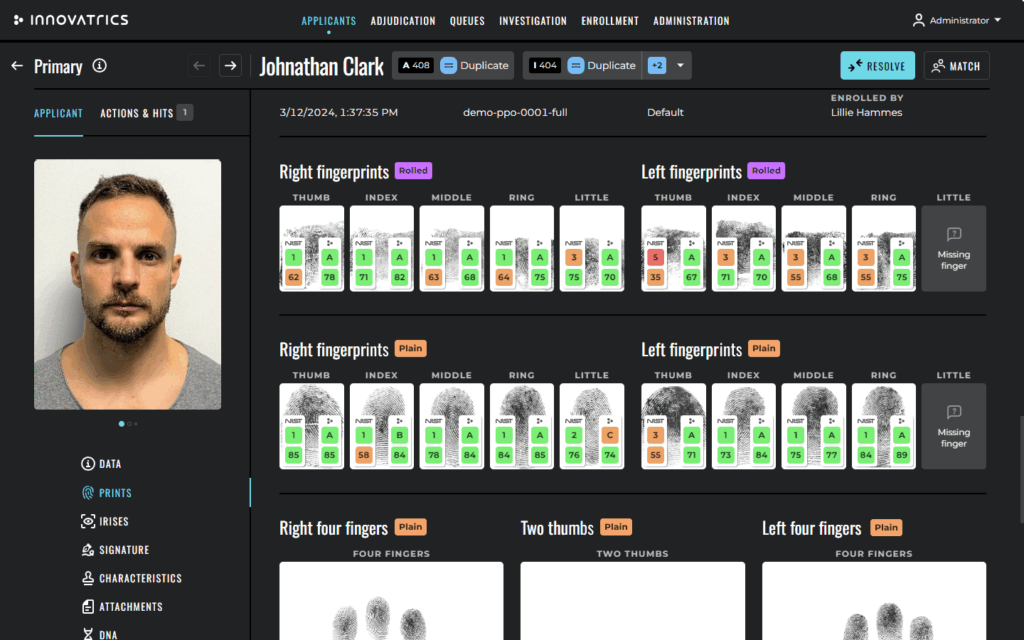
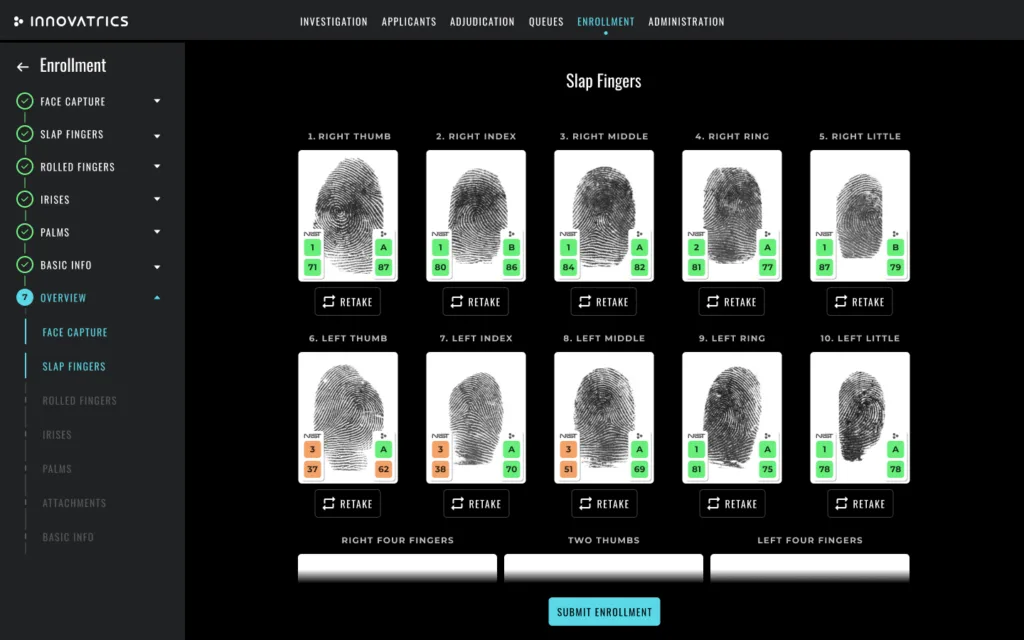
1:N deduplication is a biometric search that checks whether a person already has a record in a database. A newly submitted fingerprint, face image, iris image, or a combination of these is compared against every record already stored in the gallery. The system then returns any candidates that look similar enough to warrant a closer look. The goal is to ensure no one ends up enrolled twice under a different name, document, or account.
What Is 1:N Deduplication?
1:N deduplication is a form of one-to-many identification used to establish uniqueness. When someone enrolls in a system, their biometric data is searched against everyone already in that system. A result can point to a genuine earlier enrollment, an administrative duplicate, or someone trying to register under a new identity.
The algorithm itself has no idea why two records look alike. It calculates a similarity score and returns whichever candidates pass a configured threshold or ranking rule. What the result actually means, whether it be fraud, a coincidence, or a data entry error, is for the identity system and the people running it to decide.
What Do Probe, Gallery, and N Mean?
Three terms come up constantly in this field. The probe is the new biometric record submitted for a search. The gallery is the collection being searched, and N stands for the size of that gallery.
A gallery can be modest, a few thousand customers in a bank’s database, or enormous, tens or hundreds of millions of citizens in a national ID system. The number itself does not describe how the matching happens technically. Large Automated Biometric Identification Systems (ABIS) rely on indexing, distributed matching, and optimized templates rather than comparing a new record against every stored record one by one.
Gallery size still matters once a system gets tested. A search that performs well against ten thousand records will not necessarily behave the same way once it runs against a hundred million.
How Does 1:N Deduplication Work?
The process starts with capturing a biometric sample: a fingerprint, a face image, or an iris scan. Software checks whether the sample is good enough to work with, then an algorithm extracts its features and converts them into a template.
That template is searched against the gallery. The matching engine calculates similarity scores, and candidates that clear the search policy are returned for review. From there, a human reviewer or a set of automated rules checks the candidate against identity documents, demographic data, and enrollment history. The applicant may be accepted as a new person, linked to an existing record, or flagged for further investigation.
Keeping the biometric search and the final decision as two separate steps is what makes a deduplication process trustworthy.
1:N Deduplication vs 1:1 Matching
A 1:1 comparison checks a specific claim. The person states who they are, the system retrieves one stored reference, and compares it against the new sample. Does this person match this record? That is the only question it asks.
A 1:N search is broader. It checks whether the person might already be present anywhere in the gallery. Unlocking a phone with your face is a 1:1 comparison, since the device only checks you against the one face registered on it. Registering for a national ID is 1:N, since the applicant is checked against everyone already enrolled.
Both rely on related biometric technology, but they carry very different error profiles and consequences.
Why Threshold and Gallery Size Matter?
A matching threshold is the score a candidate needs to clear before it gets returned or flagged for review. Push the threshold up and matching becomes stricter, which cuts down false positives but risks missing genuine duplicates. Pull it down and the system catches more possible duplicates, along with more unrelated records that end up needing review.
There is no threshold that transfers cleanly from one algorithm to another. NIST has pointed out that threshold values depend on the vendor, the algorithm, and often the specific version in use, so a score from one product cannot be read on another product’s scale. Thresholds need to be set using representative data and tested at the gallery size the system will actually run at.
It is also worth being clear about what a similarity score is not. A score of 0.8 does not mean an 80 percent chance that two records belong to the same person. NIST is explicit that similarity scores should not be treated as probabilities, since the scale is not linear and varies between algorithms and even between versions of the same algorithm. A threshold should be tied to measured error rates on suitable data, not read as a percentage likelihood.
Gallery size compounds this. Every extra record in the gallery is another chance for a false match, so the odds of an unrelated record scoring high enough to get flagged rise as the gallery grows. NIST’s guidance for U.S. federal identity systems, SP 800-63A, requires providers using 1:N search for deduplication to test with a gallery no smaller than 90 percent of the size they expect to run in production. That is a requirement within that specific framework, not a rule that applies everywhere, but the underlying point holds regardless of jurisdiction. Test at something close to the real scale, or the results will not mean much.
Why Manual Review Is Still Important?
A biometric algorithm can tell you two records are similar. It cannot tell you why. That is where a trained reviewer comes in, comparing fingerprints or facial images, checking names and dates of birth, and working out whether the same photo was submitted twice or two genuinely different people just happen to look alike.
This matters more than it might seem. NIST’s own testing found that many face recognition algorithms produce noticeably higher false match rates when comparing identical twins, and to a lesser extent same-sex fraternal twins, than when comparing unrelated people of similar age and sex. Close relatives can create similar problems. None of this makes face-based deduplication useless. It means a strong facial similarity score is not proof on its own, and a second biometric modality or supporting evidence often has to settle the case.
Error rates can also differ across demographic groups depending on the algorithm, image quality, and the population being tested. NIST evaluates these differences directly in its 1:N face recognition testing, and organizations running their own deduplication systems should check performance against the population they actually serve rather than rely on a single headline accuracy number.
For anyone building or relying on a deduplication process, one requirement from that same NIST framework is worth treating as a general principle even outside U.S. federal systems. An automated search result should never be the sole reason an enrollment gets rejected. A manual review needs to confirm the finding first.
Where Is 1:N Deduplication Used?
National Identity Systems
Governments use biometric deduplication to keep one identity record per person. Before issuing an ID number or credential, the applicant’s biometrics are searched against everyone already enrolled. A genuine previous record can be restored rather than duplicated, and a candidate match goes to adjudication instead of automatic rejection. Innovatrics ABIS supports this kind of large-scale fingerprint, face, and iris matching for civil identity and voter registration programs.
Voter Registration
Electoral bodies search biometric data to catch repeated voter registrations and keep one eligible record per voter. Biometrics cannot confirm citizenship, residence, or age on their own. What they can do is flag whether two enrollment records might belong to the same person, leaving the actual eligibility decision to election law and a proper review process.
Financial Services and Telecom
Banks and fintech companies search a new applicant’s face or fingerprints against their existing customers to catch repeated sign-ups made under different names, often used to abuse credit lines or promotions.
Telecom operators do something similar during SIM registration. In both cases, a possible match should be treated as a fraud signal to investigate, combined with document checks and account history, rather than automatic proof of wrongdoing. Innovatrics ABIS can flag this kind of conflict between biometric similarity and the personal information tied to existing records.
What Makes a Reliable 1:N Deduplication System?
A few things separate a well-run deduplication system from a risky one. The purpose of the search needs to be clearly defined, and the biometric modality chosen should fit the population and environment it will actually serve. Capture quality has to be checked at enrollment, since a blurred image or a poor fingerprint scan can hide a genuine duplicate just as easily as it can create a false one.
Performance testing should reflect the real gallery size, and thresholds should be tied to measured error rates rather than guesswork. Similarity scores should never be presented as probabilities. Candidate review needs to happen before any high-impact decision, demographic performance should be checked rather than assumed, and applicants need a way to challenge a result that turns out to be wrong. None of this is optional if a system is going to be trusted with something as consequential as a person’s legal identity.
Why 1:N Deduplication Matters?
Names get spelled differently, documents get forged, and details change over time. None of that reliably reveals whether the same person has already enrolled somewhere in a system. Biometric deduplication looks at the person instead, which is why it has become central to national identity programs, voter registration, banking, and telecom.
The technology only ever produces similarity, not certainty. Its real value comes from pairing large-scale search with sound thresholds, supporting evidence, human review, and clear rules for how decisions get made.
 Fingerprint Recognition
 Facial Recognition
 Iris Recognition
 Contactless Palm Recognition
 Biometric Face Verification
 Age Estimation
 Liveness detection
 Deepfake Detection
 Identity Document Verification
 NFC Verification