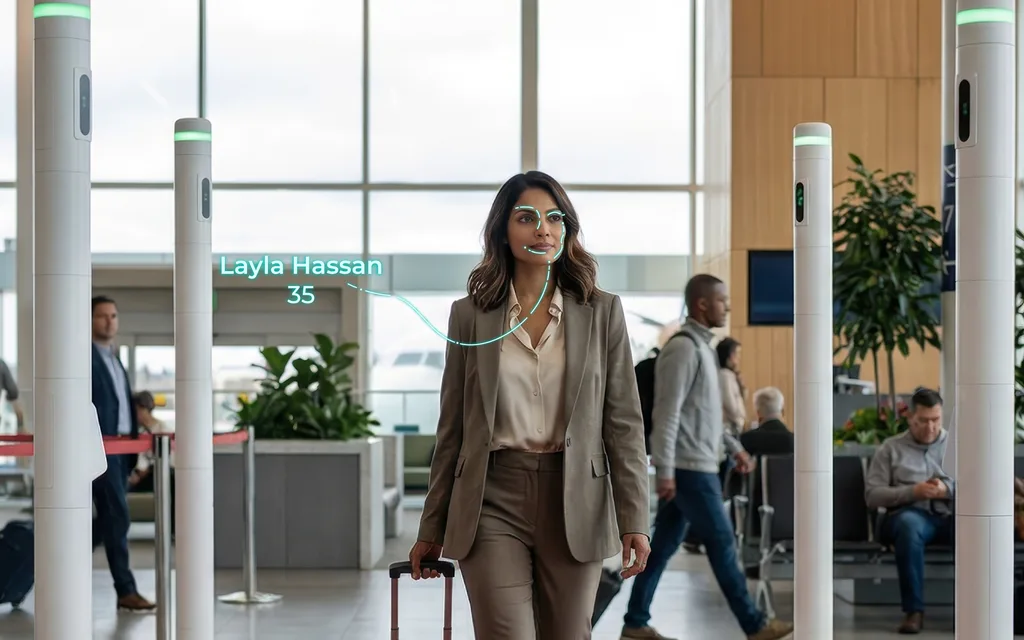
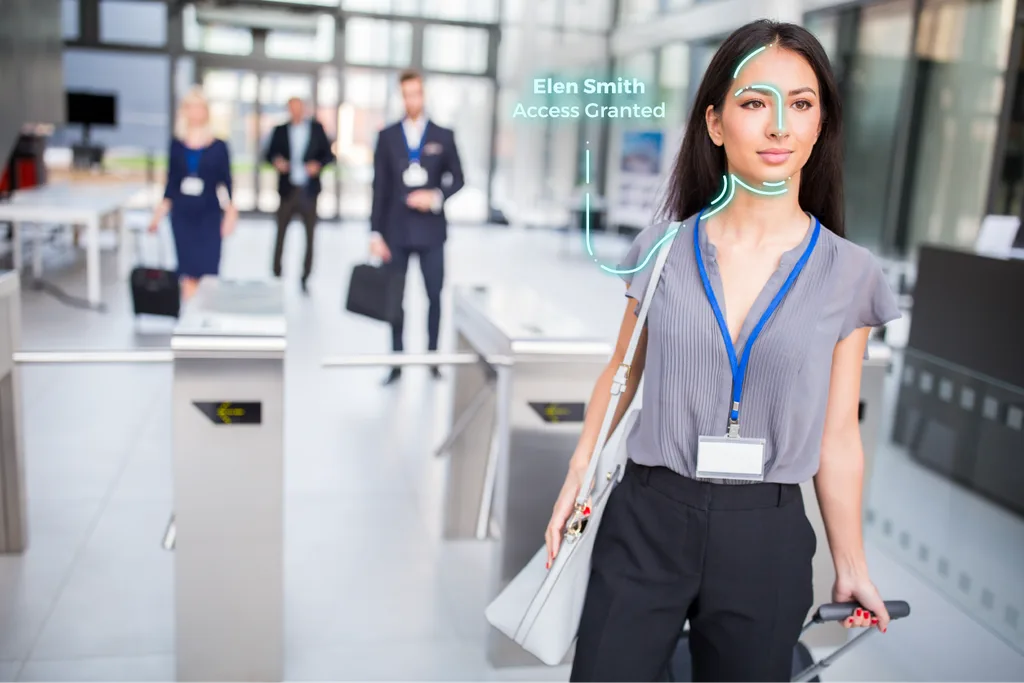
Biometric corridors are changing how airports, borders and enterprises verify identity. Rather than stopping to present physical documents, people simply walk through while face recognition confirms their identity on the move.
What Is a Biometric Corridor?
A biometric corridor is a walk-through checkpoint that identifies people with face recognition while they keep moving. Cameras along a short passage capture each person’s face, check that it belongs to a live human, and match it against an enrolled identity in real time. Nobody stops, presents a document, or looks into a scanner.
The term is most often used in border control and airports, where it is also called a smart corridor, seamless corridor, or biometric tunnel. In every case, the goal is identical: replace stop-and-check queues with identity verification on the move, without lowering the level of assurance.
A biometric corridor identifies a traveler from a face captured in motion, with no stop and no document presented.
How Does a Biometric Corridor Work?
A typical passage runs in five steps:
Enrollment. The person’s reference face is registered in advance: from the chip of an e-passport, a Digital Travel Credential, a mobile app, a check-in kiosk, or an employee badge photo. This builds the authorized gallery.
Detection and tracking. As the person enters the corridor, multiple cameras detect their face and track their body position, so every capture stays linked to the right individual.
Liveness detection. Passive liveness checks confirm the face is real and not a photo, screen replay, mask, or deepfake, with no action required from the person.
Decision. Within seconds, the system clears the person, opens a gate if one is fitted, or alerts an officer when a match fails, a person of interest appears, or someone tailgates.
Key Components of a Biometric Corridor
The accuracy of a biometric corridor depends less on the cameras than on the algorithms and the platform that ties them together.
Multi-camera capture: several angles to capture a usable face at any height or head angle.
The three approaches answer the same question — who is this person? — but differ in who does the work and when the check happens.
Manual Checks
In manual checks at the border, the officer does the work. The traveler stops at a counter and hands over a passport. An officer compares the photo with the face in front of them. This handles any case, but it is slow, and accuracy depends on a human eye at the end of a long shift.
Biometric e-Gates
Here the traveler does the work. The traveler stops at a gate, scans the passport and looks at a camera. The gate runs a 1:1 match between the live face and the photo stored in the passport chip. No prior registration is needed, so e-gates serve any eligible passport holder, but everyone still queues and stops.
Biometric Corridors
When it comes to biometric corridors, the system does the work. The traveler simply walks. Cameras capture the face on the move and run a 1:N search against a gallery of pre-enrolled people. Because the identity was linked to the face before the trip, no document is shown and nobody stops, but only enrolled people can use it.
That is why operators combine all three: corridors for enrolled frequent travelers or staff, e-gates for the wider eligible population, and officers for exceptions.
Where Are Biometric Corridors Used?
Border control: entry and exit processing at airports, seaports and land crossings, including registered traveler and Entry/Exit System programs.
Airport passenger journey: security, lounges and boarding as part of a single-token “face as boarding pass” experience.
Enterprise and critical infrastructure: frictionless employee and contractor access to campuses, data centers, energy sites and government buildings.
Venues and transport:stadium entry, ticketless rail and metro access, and VIP or accredited-staff zones at large events.
In enterprise deployments the same walkthrough replaces badges and PINs, and logs every passage.
Benefits of a Biometric Corridor
For Governments and Border Authorities
The main gain is capacity without extra checkpoints. A corridor lets officers focus on the small share of travelers who need attention. Security also improves: every person is identified, checked against watchlists and tracked through the zone rather than verified once at a desk.
For Enterprises and Operators
A biometric corridor removes badges, PINs and turnstile queues, which cuts credential sharing and lost-card costs. Every passage creates an auditable record, useful for compliance and incident investigation.
For Travelers and Employees
The result is no queue and no document handling. They experience a smooth, touchless walkthrough process where identity is verified automatically as they walk. This significantly reduces waiting times, eliminates the stress of searching for physical travel or ID documents, and provides a seamless, hassle-free entry experience.
Privacy, Security and Regulation
Biometric data is highly sensitive and requires robust safeguards to maintain public trust. As automated walk-through solutions expand, organizations must ensure that operational efficiency does not compromise individual rights. To achieve this balance, well-run deployments follow five core principles:
Consent and opt-in: in most programs, people enroll voluntarily, and an alternative manual lane remains available.
Data minimization: non-matching faces are discarded immediately; templates, not raw images, are stored; retention periods are short and defined.
Regulatory compliance: in Europe, GDPR treats biometric data as a special category, and the EU AI Act classifies biometric identification and border-management systems as high-risk, requiring risk management, human oversight and documented accuracy.
Fairness: algorithms should be independently tested for accuracy across age, gender and skin tone, for example in NIST evaluations.
Attack resistance: liveness and injection-attack detection, ideally certified to standards such as ISO/IEC 30107-3.
The Future of Smart Biometric Corridors
Biometric corridors are moving from pilots to standard infrastructure. Three trends are driving the shift today:
Digital identity before the trip:Digital Travel Credentials and mobile wallets will let people enroll from their phone, so more travelers arrive already eligible for the corridor.
Connected journeys: one biometric enrollment will open every touchpoint, from check-in and security to boarding, border exit and hotel arrival.
Stronger defenses: as deepfake and injection attacks grow, certified liveness detection and continuous algorithm updates will become baseline requirements.
The winners will be the operators that pair speed with transparency, proving to regulators and the public that seamless also means accurate, fair and secure.
 Fingerprint Recognition
 Facial Recognition
 Iris Recognition
 Contactless Palm Recognition
 Biometric Face Verification
 Age Estimation
 Liveness detection
 Deepfake Detection
 Identity Document Verification
 NFC Verification