Latent Fingerprint definition
In the hierarchy of forensic evidence, latent fingerprint identification remains the gold standard for individualization. For government and law enforcement bodies, the capacity to recover and successfully match these concealed prints is vital for positive judicial outcomes and maintaining public safety. As biometric technology evolves, the shift from manual examination to AI-driven Automated Biometric Identification Systems (ABIS) has revolutionized how agencies solve crimes.
What Is a Latent Fingerprint?
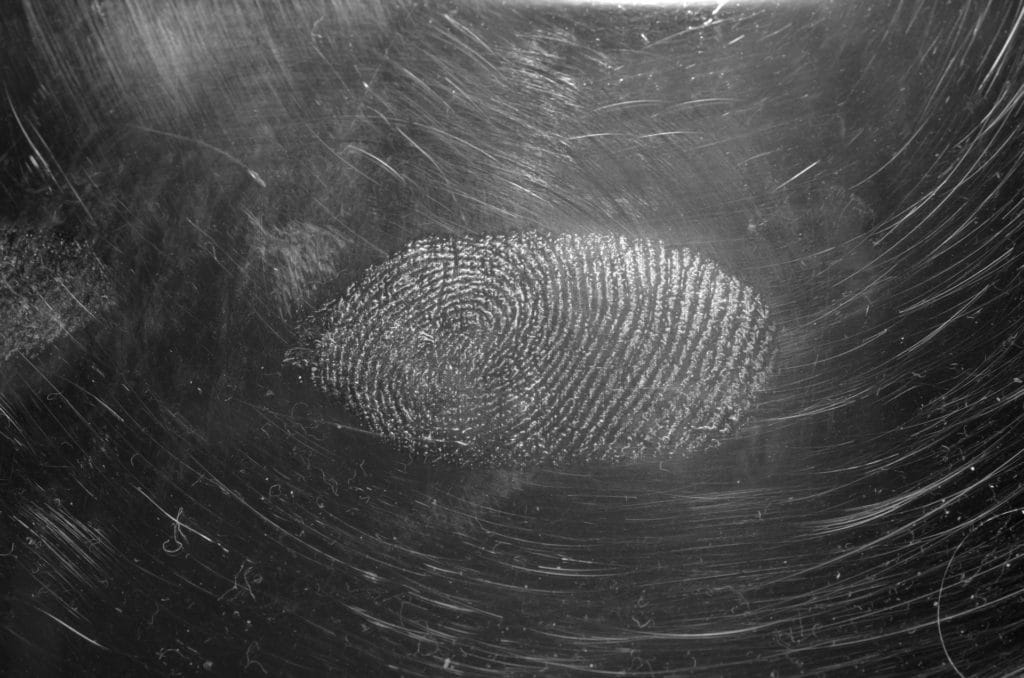
A latent fingerprint is an invisible or barely visible impression of the friction ridge skin of the fingers or palms. It is formed by the transfer of natural secretions, primarily sweat (water, salts, and amino acids) and sebum (oils) or contaminants like blood or dust from the skin to a surface. Because these prints are unintentional, they are often partial, distorted, or overlapping with other prints.
The term “latent” comes from the Latin latens, meaning hidden and that hidden quality is precisely what makes them so forensically significant.
Patent vs. Plastic Fingerprints
To understand the complexity of latents, it is essential to distinguish them from other types:
- Patent Fingerprints: Visible to the naked eye, formed when fingers contaminated with a substance (like ink or blood) touch a surface.
- Plastic Fingerprints: Three-dimensional impressions left in soft materials like wax, soap, or wet paint.
- Latent Fingerprints: Require physical or chemical “development” to be made visible for analysis.
Friction Ridge Skin
Friction ridge skin is the term for the skin covering the palms of the hands and the soles of the feet. It is characterized by a series of distinct ridges and valleys. These patterns are unique to each person and remain unchanged throughout their life, serving as the biological foundation for biometric identification.
The Three Levels of Fingerprint Features
To understand how modern algorithms match latent fingerprint evidence, one must understand the hierarchical nature of fingerprint features. Automated systems like Innovatrics ABIS utilize these levels hierarchically to ensure accuracy:
- Level 1 (Pattern): Refers to the overall ridge flow (e.g., loop, whorl, arch). While useful for database categorization, these features are not unique enough for individualization.
- Level 2 (Minutiae): These are specific points where ridges change, such as bifurcations (ridges splitting) and ridge endings. Most traditional AFIS (Automated Fingerprint Identification Systems) rely heavily on minutiae. However, latent fingerprint impressions often contain fewer than 8-10 minutiae, making matching extremely difficult.
- Level 3 (Pores and Ridge Contours): This includes the shape of the sweat pores and ridge edge contours. High-resolution scanning (1000 ppi or higher) allows systems to utilize these microscopic features. Studies confirm that integrating Level 3 features significantly improves the accuracy of partial latent fingerprint matching by providing additional data points beyond traditional minutiae.
Latent Fingerprint Development and Collection
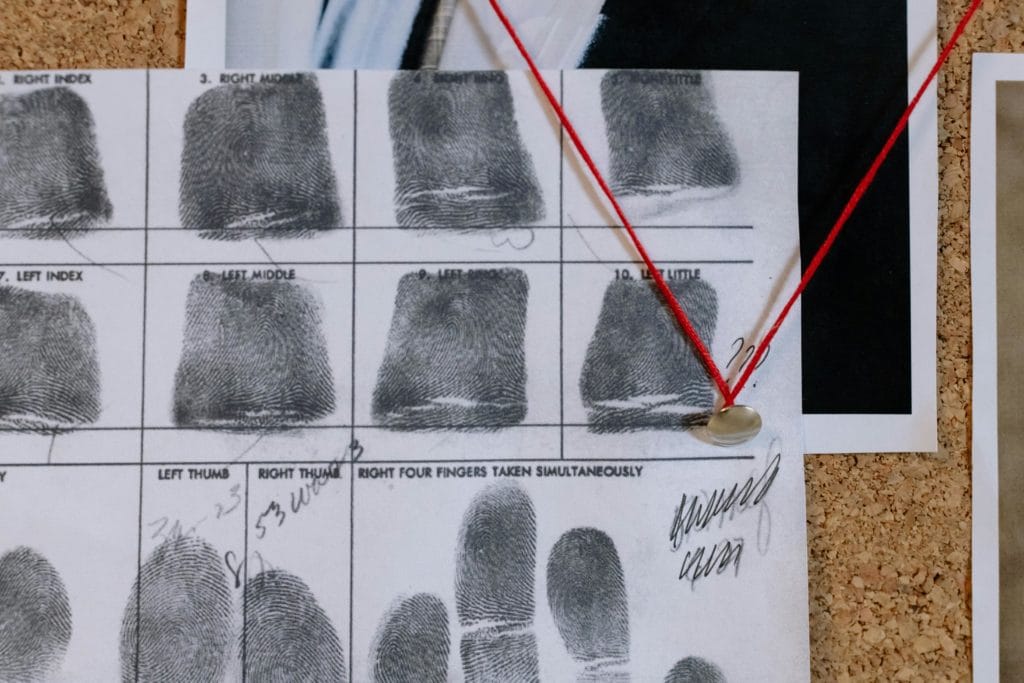
Latent fingerprints must first be located and made visible before they can be digitized and matched. The selection of development methods is determined by the type of surface and the environmental exposure.
- Dusting with fingerprint powder: The most widely used technique for non-porous surfaces. Aluminum, carbon, and fluorescent powders adhere to the oily residue of the ridge deposits.
- Cyanoacrylate (superglue) fuming: Superglue vapors polymerize on the amino acids and sebaceous residues of a latent print, producing a white, hard coating ideal for non-porous surfaces.
- Ninhydrin: A chemical reagent that reacts with amino acids in sweat residue, producing a purple compound (Ruhemann’s purple). Highly effective on porous surfaces such as paper.
- 1,8-Diazafluoren-9-one (DFO) and Physical Developer (PD): Advanced reagents used for aged prints or prints on wet or challenging substrates.
- Vacuum Metal Deposition (VMD): A laboratory-grade technique using gold and zinc to develop latent prints on plastics and other difficult surfaces with exceptional sensitivity.
Latent Print Examiner (LPE)
A trained forensic specialist responsible for the recovery, analysis, comparison, and evaluation of latent fingerprints. Latent print examiners follow the ACE-V methodology (Analysis, Comparison, Evaluation, Verification) to reach identification conclusions. Modern examiners increasingly work alongside AI-powered tools that prioritize candidate lists, flag potential matches, and support decision-making, significantly improving throughput without replacing expert judgment.
ACE-V Methodology
The standard scientific methodology used in forensic fingerprint examination:
- Analysis – examining the latent print in isolation to assess quality, identify features, and document observable characteristics.
- Comparison – comparing the latent print against a known exemplar.
- Evaluation – reaching a conclusion of identification (individualization), exclusion, or inconclusive.
- Verification – having a second, independent examiner repeats the process to confirm the conclusion.
Deep Learning in Latent Fingerprint Matching
Modern latent fingerprint identification has been transformed by convolutional neural networks and other deep learning architectures. These models learn feature representations directly from fingerprint image data, capturing ridge flow, pore structure, and incipient ridges that traditional minutiae-extraction pipelines may miss.
NIST ELFT (Evaluation of Latent Fingerprint Technologies)
The National Institute of Standards and Technology (NIST) conducts periodic independent evaluations of latent fingerprint technology performance across the industry. The NIST ELFT benchmark is the authoritative standard for comparing AFIS and ABIS vendors on latent print search accuracy. Innovatrics consistently performs among the top-ranked providers in NIST evaluations, reflecting the real-world reliability of its latent fingerprint matching engine.
Why Latent Fingerprint Matters for Governments and Enterprises
For government entities and large-scale enterprises, the implementation of a high-tier latent fingerprint solution offers more than just forensic evidence; it provides a framework for national security and public trust.
Latent fingerprint capabilities meet the rigorous demands of mission-critical environments. They empower you to modernize national forensic databases, deploy border control biometric systems, or build civil deduplication platforms:
- Public Safety: Faster identification of suspects leads to higher clearance rates for crimes.
- Border Integrity: Identifying “persons of interest” who may have used aliases but left latent traces in past incidents.
- Civil Registry Accuracy: Ensuring that identity records are not duplicated or fraudulent by cross-referencing latent data from historical archives.
The Future of Latent Fingerprint Analysis
The next decade will see several key trends in latent fingerprint analysis:
- Mobile Forensics: Field agents will use portable devices and mobile ABIS to check latent fingerprint evidence against databases in real time, accelerating investigations.
- Multimodal Integration: Seamlessly linking latent fingerprint data with palm prints, faces, and iris recognition to build comprehensive suspect profiles.
- Advanced Pore Mapping: As sensor resolution increases, the use of Level 3 features (pores) will become standard in automated systems, allowing for the identification of individuals from incredibly tiny fragments of ridge skin.
The science of latent fingerprint identification has moved far beyond the era of magnifying glasses and ink pads. It stands at the intersection of traditional forensic science and cutting-edge artificial intelligence. For law enforcement agencies, the ability to rapidly and accurately process these hidden impressions is no longer a luxury but a necessity. By understanding the terminology from minutiae to FNIR and the technical benchmarks set by NIST, organizations can make informed decisions about their biometric infrastructure.
