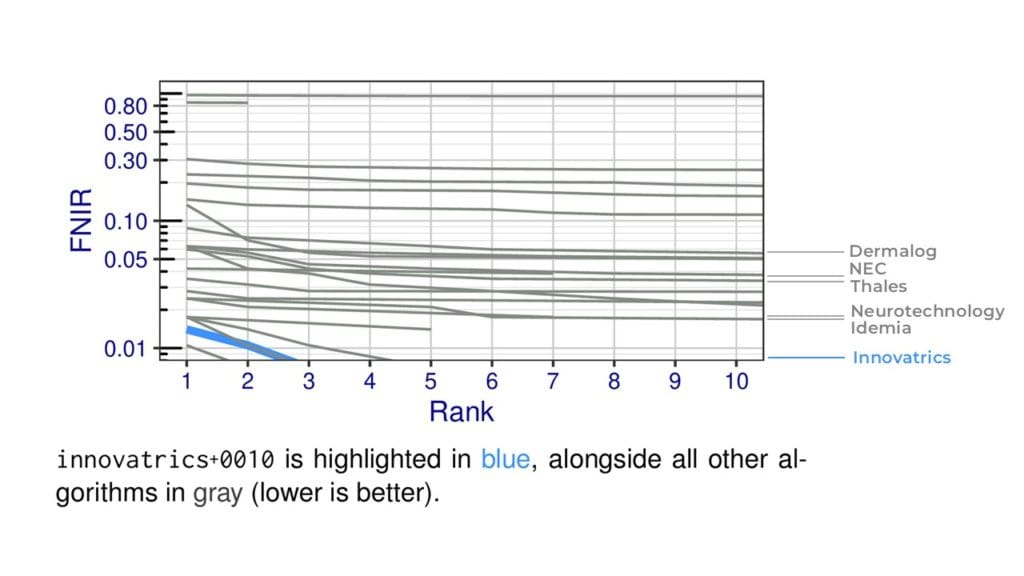


Innovatrics Achieves 6x Fewer Misses in NIST FRIF TE E1N Class A Fingerprint Identification Test
NIST’s Friction Ridge Image and Features (FRIF) Technology Evaluation (TE) Exemplar One-to-Many (FRIF TE E1N) benchmark measures how ...
Read moreInnovatrics’ latest submission to the NIST ELFT benchmark confirms its latent fingerprint algorithm among the most accurate in the world for FNIR at rank ≤1, delivering the best performance among leading biometric technology providers.

NIST Evaluation of Latent Fingerprint Technologies (ELFT) consists of evaluations of the accuracy of latent matching using features marked by experienced human latent fingerprint examiners. This test aims to evaluate the current state of the art in latent feature-based matching by comparing the accuracy of searches using images alone with searches using different feature sets.
Being among the best in the rank-1 category is particularly important because it makes the lives of examiners easier and reduces time spent on manual comparison by quickly identifying the correct match.
In the FBI Provided Solved dataset #1, a dataset consisting of 516 operational probes collected from a particular type of crime, Innovatrics has achieved a rank-1 hit rate of 98.6%.
Hit rate is the most important metric derived from FNIR (false negative identification rate), and the resulting value is the percentage of times that the correct subject appears at or above a rank in the candidate list. This is nowadays the most widely used method by fingerprint laboratories across the world where the results are reviewed manually.


In the DoD Dataset #1 — the most recent and largest dataset with 5,259 probes collected operationally by the United States Department of Defense — Innovatrics has remained as one of the most accurate algorithms in both rank and threshold-based search, further strengthening its position as a leading provider of cutting-edge biometric solutions.


The Search with threshold category measures the balance between two errors, FNIR and FPIR, where non-matching candidates are filtered out automatically based on similarity score. A higher threshold likely corresponds with fewer subjects for manual review, which saves the operator time. This is also NIST’s preferred accuracy metric because operating costs tend to grow with these two errors.
Innovatrics latest achievement highlights the exceptional quality of its algorithms, especially given that they currently outperform industry leaders and well-established competitors.
Results shown from NIST do not constitute an endorsement of any particular system, product, service, or company by the U.S. Government.
