Age Verification definition
Age verification is a secure way to confirm someone’s age, such as proving they are over 18, 21, or another required age. Instead of just asking someone to enter a birth date, age verification requires reliable proof, which can include: an official ID (such as a driver’s license or passport), trusted records from a verified source, or biometric data (i.e., facial features).
Understanding Age Verification vs. Age Estimation
While often used interchangeably, age verification and age estimation represent distinct approaches.
- Age verification involves matching a person to trusted evidence (such as a government ID containing a date of birth) to confirm their age. This process yields a high-confidence, legally defensible “yes” or “no” decision.
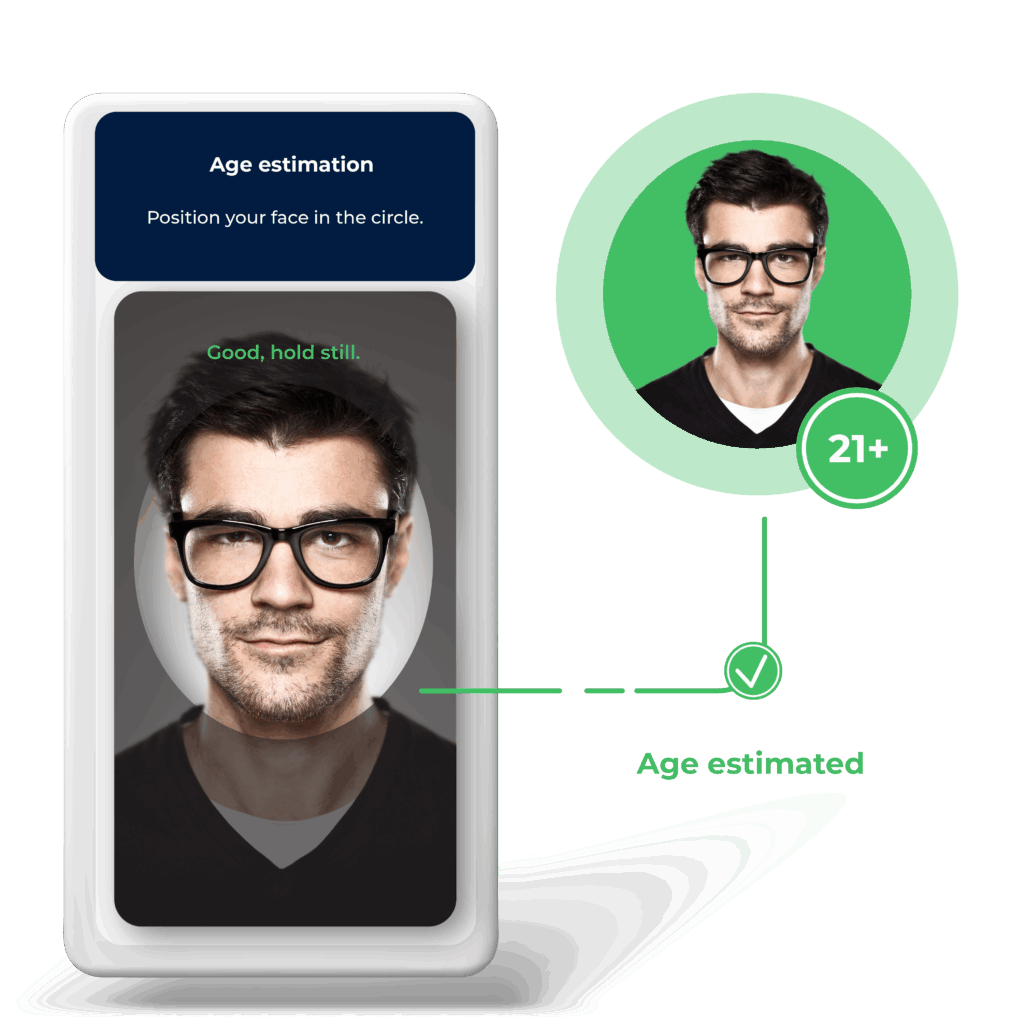
- Age estimation uses artificial intelligence to predict an approximate age range by analyzing facial features without requiring identity documents. Organizations typically implement age estimation as a first-line screening tool, triggering full age verification only when users appear under the threshold age.
In practice:
- Use verification when legal certainty is required (regulated content, border control, financial services).
- Use estimation as a risk-based pre-check or where laws allow probabilistic methods.
International standards such as IEEE 2089.1 and the emerging ISO/IEC 27566 age assurance framework explicitly distinguish these approaches and define performance, privacy, and acceptability expectations.
How Does the Age Verification Process Work?
Modern age verification combines multiple biometric modalities to achieve accuracy rates exceeding traditional methods. The process typically involves:
Document Verification
Advanced optical character recognition (OCR) extracts data from government-issued IDs, passports, or driver’s licenses. The system analyzes security features, holograms, and microprint patterns to detect fraudulent documents.
Facial Recognition
Algorithms compare the facial biometrics from the document photograph with a live selfie captured during verification. This matching process occurs in milliseconds, searching databases while maintaining user privacy.
Liveness Detection
Sophisticated anti-spoofing technology ensures the person being verified is physically present, not a photograph, video, or deepfake. Passive liveness detection analyzes natural micro-movements, texture patterns, and depth information without requiring users to perform specific actions.
Age Estimation Algorithms
When documents aren’t available, AI-powered facial analysis estimates age by evaluating features that correlate with biological age. These algorithms achieve Mean Absolute Error rates as low as 2-3 years across diverse demographics.
Global Regulatory Landscape for Age Verification
The regulatory environment for age verification has intensified dramatically since 2023. In 2025, over 25 U.S. states enacted age verification requirements for adult content websites, with laws also expanding to social media platforms and app stores. In June 2025, the U.S. Supreme Court upheld Texas’s age verification law, validating the constitutional framework for such requirements.
Internationally, the UK’s Online Safety Act mandated highly effective age verification for high-risk services in July 2025, with penalties reaching 10% of global turnover. The European Union’s Digital Services Act similarly imposes age assurance obligations on platforms accessible to minors. Australia has committed significant resources to age verification trials and is implementing minimum age requirements for social media access.
These regulations reflect a global consensus: protecting minors online requires technological solutions that balance safety, privacy, and user experience.
Key Technologies Enabling Age Verification
Document Verification
The multi-layered document authentication process is used for age verification and identity document integrity. The process includes:
- Data Extraction: Using Optical Character Recognition (OCR) to extract textual data and reading the Machine Readable Zone (MRZ) and Barcodes for automated data retrieval and validation.
- Physical/Digital Security Checks: Employing Document Template Matching to compare the document’s layout and security features against known genuine templates, and for electronic IDs/e-passports, Chip Reading (NFC) to verify securely stored data and the issuing authority’s digital signature via PKI.
- Fraud Detection: Utilizing advanced algorithms and forensic techniques for Forgery and Tampering Detection to identify physical or digital manipulation.
The entire process is significantly enhanced by integration with external issuer databases or digital registries to perform real-time verification of the document’s status directly with the issuing government body.
Face Biometrics and 1:1 Matching
Confirms that the person presenting the ID is its rightful holder by matching their live selfie to the ID photo. This process is crucial in preventing identity theft and fraudulent use of documents. The result is a high-confidence assurance that the individual is who they claim to be.
Passive and Active Liveness Detection
Detects spoofing attempts (prints, screens, masks, deepfakes). Passive liveness works without user actions; active liveness asks for gestures. Strong liveness is essential for online age verification trust.

Facial Age Estimation Models
AI models trained to infer age bands. NIST evaluates these algorithms to benchmark accuracy and bias, showing meaningful variation between vendors.
Digital ID Wallets and Verifiable Credentials
Government or issuer-provided credentials can confirm “over X” without revealing extra identity data, supporting privacy and scaling.
Risk Engines and Policy Orchestration
Blend signals (device integrity, fraud checks, behavioral analytics) to decide when to escalate from estimation to full verification. This multi-layered approach enhances the accuracy and reliability of age verification processes. It ensures that robust verification is only applied when necessary, optimizing the user experience while maintaining high security and compliance standards.
Industry Applications of Age Verification
Age verification has transitioned from a niche requirement to a fundamental, mainstream component across a multitude of sectors. This necessity is driven primarily by the existence of legal access rules, the imperative to mitigate safety risks, and the need to protect vulnerable populations, particularly minors.
Government and Border Control
This sector utilizes age verification for national security and citizen management. Applications include:
- eGates and Automated Border Control: Ensuring travelers meet the legal age requirements for independent travel or specific entry protocols.
- Visa and Immigration Systems: Validating age as a criterion for various visa categories.
- National Digital Identity Programs: Establishing and maintaining secure, age-validated digital identities for government services and transactions.
- Youth Protection Services: Implementing and enforcing age-based restrictions and safeguards mandated by law.
Online Safety and Social Platforms
Given the prevalence of online content and social interaction, age verification is critical for child safety and legal compliance. This includes:
- Access Restrictions to Harmful Content: Preventing minors from accessing sexually explicit material, graphic violence, or content promoting illegal activities (e.g., age-gating adult websites).
- Age-Limited Features: Controlling access to platform features such as direct messaging, financial transaction capabilities, or public broadcasting features until a user reaches a specified age.
- Compliance with Legislation: Meeting the requirements of child protection and data privacy laws (e.g., COPPA in the US, GDPR-K in Europe).
Retail and eCommerce
The sale of age-restricted goods requires robust verification to ensure compliance and avoid severe penalties. Relevant areas include:
- Controlled Goods Sales: Verifying the age of purchasers for products like alcohol, tobacco, vaping products, and cannabis (where legally permitted).
- Restricted Items: Ensuring the legal sale of items such as knives, solvents, and certain pharmaceuticals that have age limitations.
- Lotteries and Gambling Products: Verifying the legal age for participation in local and national lotteries and purchasing scratch cards.
Financial Services
Age verification is integral to compliance with Know Your Customer (KYC) regulations and managing financial risk.
- Youth Account Opening: Establishing accounts for minors (often requiring parental consent) with appropriate restrictions.
- Credit Products and Loans: Ensuring applicants meet the legal age of majority required to enter into binding credit agreements.
- General KYC Workflows: Using age validation as a core component of identity verification during account onboarding.
Travel and Hospitality
Integrating age checks into the customer journey for services that have legal age requirements.
- Check-in Kiosks: Verifying the age of the primary guest for hotel or flight bookings.
- Car Rental: Ensuring drivers meet the minimum age required by the rental company and insurance policy.
- Duty-Free and Restricted Sales: Verifying age for the purchase of alcohol, tobacco, and other controlled products in airports or on cruise ships.
Best Practices for Age Verification Deployment
Organizations implementing age verification should prioritize solutions that combine high accuracy with privacy protection. Select vendors with proven performance in independent benchmarks like NIST Face Analysis Technology Evaluation, which objectively measures algorithm accuracy across diverse populations.
Choose systems offering passive liveness detection to reduce friction while maintaining security. Implement privacy-by-design principles, minimizing data collection and retention. Consider hybrid approaches that use age estimation as an initial filter, reserving full document-based verification for borderline cases.
Ensure compliance with industry standards, including ISO/IEC 30107, for presentation attack detection. Design user interfaces that guide customers clearly through verification steps, with support for users requiring assistance.
Difference Between In-Person and Online Age Verification
- In-person age verification typically involves a human inspector checking a physical ID and sometimes comparing it to the holder. It benefits from contextual cues but is inconsistent, hard to audit, and doesn’t scale.
- Online age verification relies on digital evidence capture and automated checks. It scales globally, supports 24/7 services, and creates verifiable audit logs, but depends heavily on biometric quality, liveness, and document authenticity detection
Many governments and enterprises now adopt hybrid models, using online age verification for remote services and in-person checks for exceptional or high-risk cases.
The Future of Age Verification Technology
The global age assurance market is projected to grow from $5.7 billion in 2025 to $10.4 billion by 2029, driven by regulatory enforcement and demand for safer online environments. Future developments will likely include:
Enhanced AI Capabilities: Machine learning models will continue improving accuracy while reducing bias across demographic groups. Algorithms will better handle challenging conditions like poor lighting, partial occlusions, or non-frontal poses.
Reusable Digital Credentials: Users will verify their age once through trusted providers, then share cryptographic credentials across platforms without repeatedly uploading identity documents.
Behavioral Biometrics Integration: Analysis of typing patterns, device interaction, and usage behaviors will supplement facial recognition for continuous age assurance.
Standardization and Interoperability: Industry standards will emerge, allowing verified credentials to work seamlessly across platforms while maintaining privacy and security.
